Tuesday, August 19, 2014

The Foremost Task of Education

"I regard it as the foremost task of education to insure the survival of these qualities: an enterprising curiosity, an undefeatable spirit, tenacity in pursuit, readiness for sensible self denial, and above all, compassion." - Kurt Hahn


My family and I have had a memorable summer.  From road tripping - to waterfalls - to funerals - we have logged many meaningful experiences.  But now I am excited about the new school year.  I am so ready to meet my new students, and get to know them, and their families.  Mostly, I am excited about the possibilities that come along with all of these new people who are about to enter my life.  I have said it before, but there is simply no substitute for the energy of the first day of school.  

And I am especially excited this year, as my youngest child is starting Kindergarten.  His adventure in public education is just beginning, and I love to see his beginning with new eyes.  It especially helps renew my fire for education. 

For me, getting the opportunity to engage in thoughtful discussion about the history of humans is about as good as it gets.  And I am chomping at the bit to dive in.  But that is not my primary goal. As the above quote best illustrates - it is my foremost task that my students (and I) will become more compassionate, spirited, and curious people as a result of our knowing, and learning, with one another.

So... Lets. Do. This.

Wednesday, August 6, 2014

Small Classes {What if They Are Not So Great?}

Recently, I read Malcolm Gladwell's David and Goliath- a book that studies how underdogs achieve. I enjoyed it, but was particularly struck by his chapter that focused on class size.

According to his collection of research, the relationship between class size and student achievement is actually an inverted U curve (below).  That in reality, classes that perform poorly are (most often) either too big, or too small.

So, there is a sweet spot - and that does not surprise me.  From my personal experience, the perfect class size is anywhere from 18 to 26 students.  Anything less, and it is challenging to create critical mass movements, especially when the class does not include many peers.  Happy students are the best students, so classes work better when students are surrounded by (and inspired by) their peer groups. Small classes make that very scenario less likely.  Of course, in classes that are larger than 26,  personal relationships are almost impossible to cultivate.

I am looking forward to (hopefully) teaching classes this upcoming year that are not tiny - but right in the sweet spot.

Friday, July 18, 2014

The Fourth Wall.

I love getting to know my students.  If anything, I am an extremely social person - so teaching 80 teenagers per day is perfect for me.  I love to learn about their families, histories, and passions - and I enjoy most of the experiences that we have together throughout the year. In addition, most of my students (and their families) learn about my life history, and often hear stories about my family, travels, and experiences through my teaching.  

That being said, I work diligently to maintain healthy and well defined boundaries with my students, always with the hope that they have a clear understanding that I am their teacher, not a casual friend or buddy.   So I stress that my personal life is not something that my students are allowed to cross in to.  Generally, they are respectful of these lines, and I am always appreciative of it.

But I am a big believer that successfully teaching someone anything is a social experience - and one that must be understood from a personal perspective.  To learn, I mean really learn, we have to connect to it personally.  To that end, I break down the fourth wall in my classroom.  I learned about the fourth wall concept as a young theater student, and it is defined as such, "The fourth wall is the imaginary "wall" at the front of the stage in a traditional three-walled box-set theater.  Speaking directly to or otherwise acknowledging the audience through this imaginary wall in a play, is referred to as "breaking the fourth wall." Think Ferris Bueller (or at a Ryan Adams concert) speaking directly to the audience - it is endearing.  And it helps all of us root for him down the stretch.  

In order to truly teach my students history, I often have to present stories (of the Romans, wars, myths, etc.) to them - and teach them analysis.  But when I make mistakes, or when I see that a personal story from my life may better explicate the idea - I break the fourth wall and speak directly to my students.  When I am enforcing the tardy policy, or discussing grade percentages at the end of the semester - I am performing a professional duty - and all of my students know that.  But they also know that I am a normal, vulnerable human being who is working a job, and lives his life outside of that job.  


I believe that one of the biggest pitfalls that teachers fall into is hiding behind that fourth wall of professionalism, at the expense of developing positive relationships with students, and/or showing any vulnerability in the classroom.  So while my boundaries are real - by the end of the year, my students (and their families) and I really know each other well. Reconciling the balance between healthy boundaries and healthy teacher/student relationships is a huge part of teaching - and I hope that I can continue to find the sweet spot in that effort.

Monday, July 7, 2014

Test Scores {are not everything}

It is that time of the summer when all AP scores are posted.  This can be a time of great relief, or disappointment, for all of the students, families, and teachers involved in Advanced Placement classes.  I find that it is important for us to remember that our learning experiences always equal more than the sum of our test scores.  

That being said, most of us hope to see a score on our AP exam that reflects our work in the course - and that is not always the case (especially when we are dealing with an exam that covers....wait for it...10,000 years of history, throughout the entire globe).

But to provide some perspective on the AP World History exam - I thought I would post the 2014 score distributions, including every AP World History student in the entire nation.  It is my hope that students can gain some clarity about their scores by looking at the distributions.  So here it is:

2014 AP World History Score Distributions (National)
5 - 6.4%
4 - 15.8%
3 - 31.7%
2 - 27.9%
1 - 18.2%

53.9% of all students scored a 3 or above on this year's exam.

Wednesday, June 11, 2014

The Homestretch

Wrapping up a year in public school is always bittersweet for me.  On one hand, I am a restless spirit - and jump at the opportunity to spend my days doing something outside of school.

There is a certain beauty about routine, and teaching fulfills that perfectly.  My life is sectioned out according to bell schedules, teacher work days, and holiday breaks for ten months of the year.  So, the summer is a time that I typically reserve for anything but academic pursuits, or attempting to motivate others.

But, at some point in every summer - I begin to miss the students and their excitement.  I have enjoyed a great year with most of my classes.  This year (like every year) brought a new set of challenges, and also opportunities to try new things.  The Chicago trip was the highlight of the year, bringing all of us closer together - and opening our eyes to new experiences.  Travel has a way of accomplishing that, where others experiences can not.

But in my many years of teaching, I have never witnessed such anxiety among teachers and staff about the direction of NC public schools.  Everyone is on edge about every aspect of teaching in this state, and it is disheartening.  It is my hope that North Carolina will make decisions that will have a positive impact on our schools this year.  It is too sad to think of the alternative.

We finished up with national exams (AP), State exams (NC), service projects, and mural painting.  Overall, a solid end to a good year.  I feel grateful for the opportunity to spend my days with these kids.

Friday, May 30, 2014

Anybody Can Serve

“Everybody can be great...because anybody can serve. You don't have to have a college degree to serve. You don't have to make your subject and verb agree to serve." - Martin Luther King Jr.

The College Board administers the AP World History exam in the second week of May each year.  This is a national exam, and the date is not flexible.  As a result, AP classes must cover material quicker, and be prepared for their major assessment earlier.  Once the exam is complete, we usually have just a few days before our state and local exams begin.  This year however, we missed numerous days throughout the winter due to snow - and we are in school until June 12.  So, my AP classes have an opportunity to complete other projects.

It is an opportunity for us to give back.

In the past, we have painted many murals, put on fundraiser rock shows, had guest speakers, etc.  This year, we are completing a hallway mural, and working with Asheville Greenworks and the NBHS custodians to complete campus cleanup and landscaping.  Asheville Greenworks provided the supplies for us, and the custodial staff provided the list of priorities.  We are providing 52 teenagers to do the work.

I hope it helps, and I hope the students realize that it does not take much to make a difference.
Everyone can make a difference, because everyone can serve.

Tuesday, May 20, 2014

Chicago {We pulled it off}

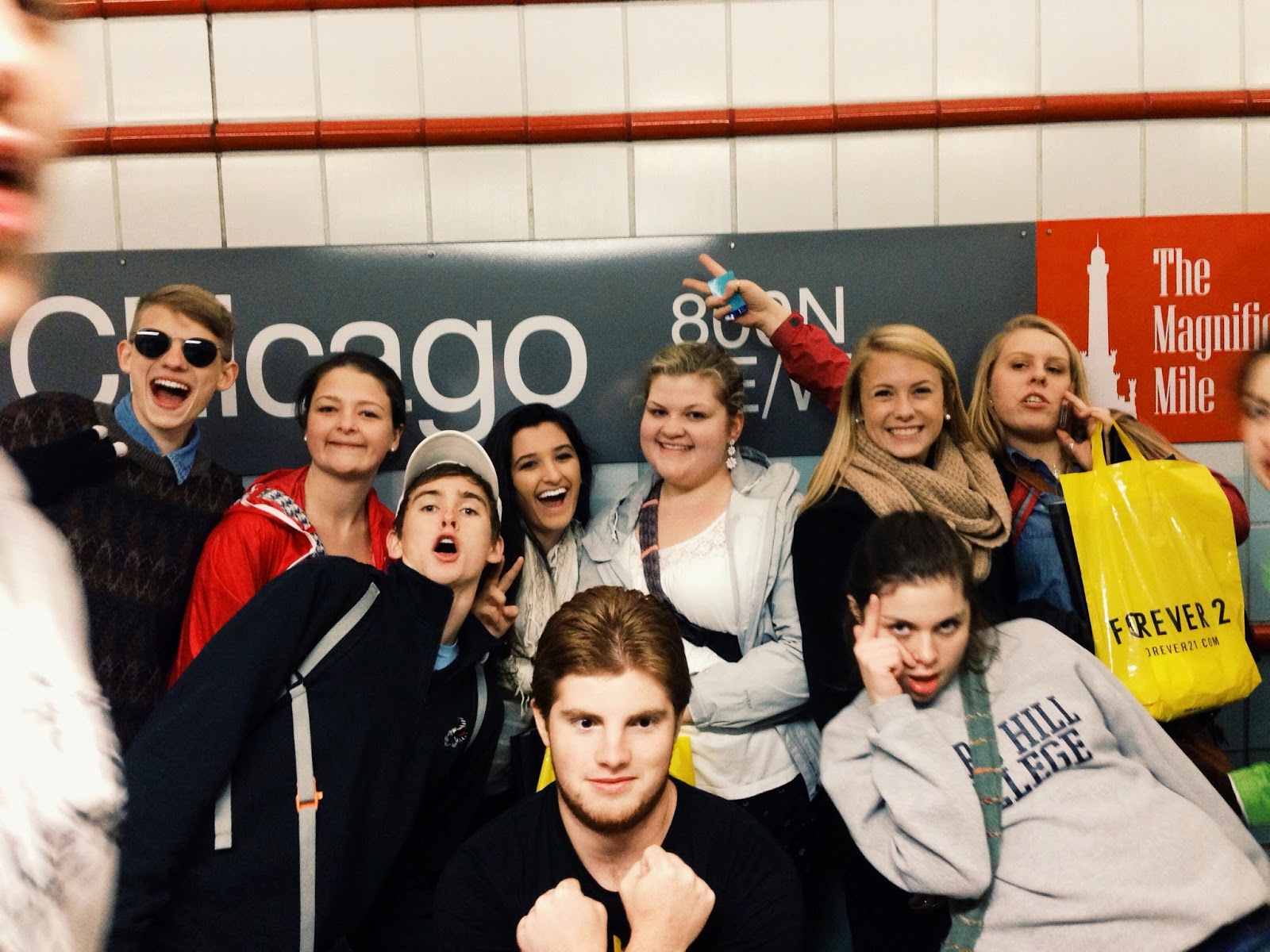
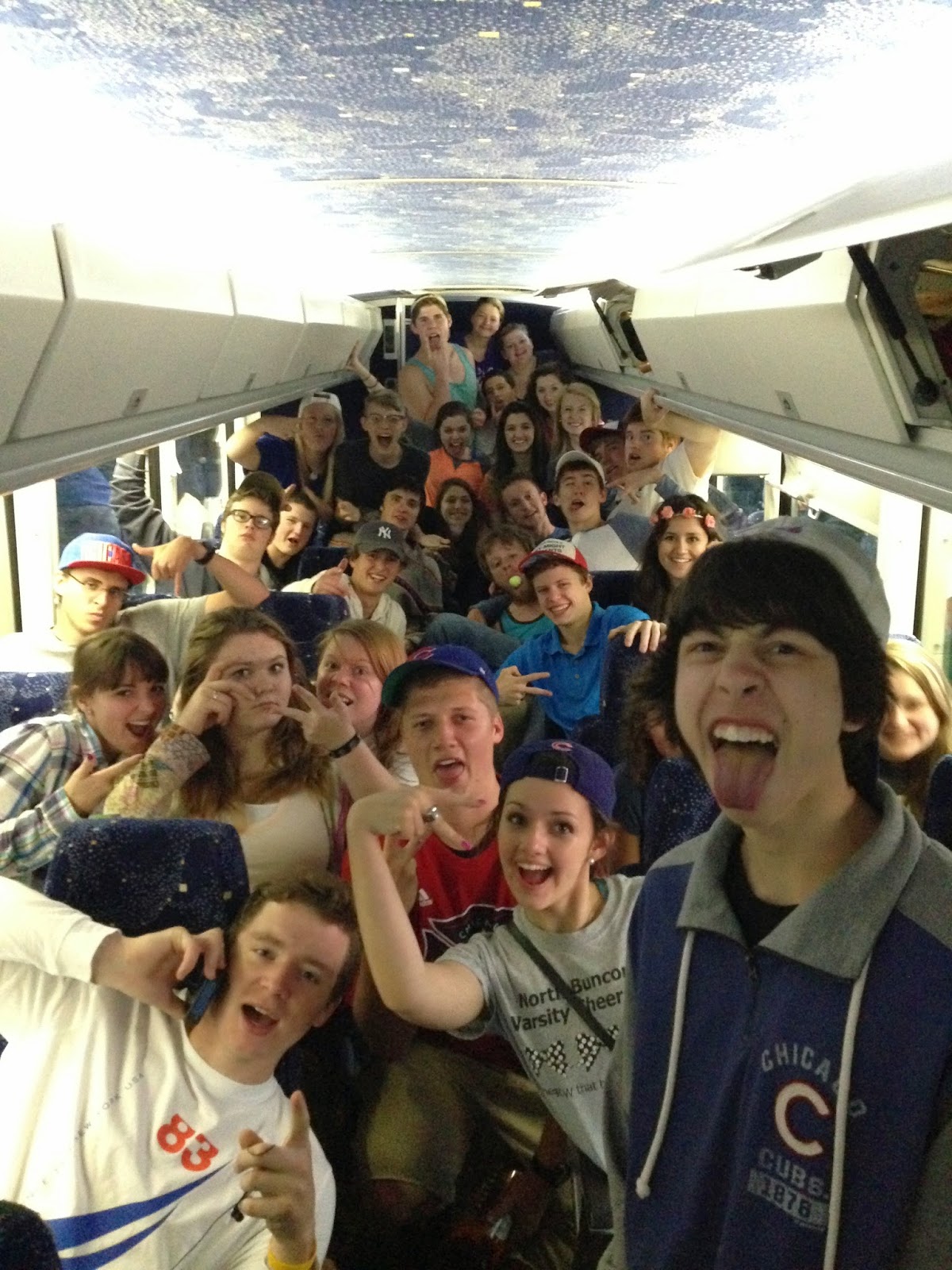
41 students, 5 teachers, 1 bus, 3 days - in Chicago.  We planned this trip back in January, with audacious hopes for success. And this past weekend, we pulled it off.  It was amazing.  I fell in love with the city of Chicago over the weekend, but came away with even more adoration for the 41 students who
traveled with me.  We had the best time, and soaked up the spirit of Chicago, as it were.

Traveling with great high school kids is not for the feint of heart, but it is exhilarating.  If you remember what  it felt like to be 16 years old, then maybe you remember the reckless confidence that was baked into your brain.  I certainly remember that feeling when I was lucky enough to spend three weeks in Europe as a 17 year old. Our teachers trusted us to navigate cities like Rome, Venice, Lucerne, Paris, and London - and we did it with enthusiasm and naivete.  It built my confidence, and inspired me to learn more, travel more, and open my mind to new experiences. That trip was a catalyst for me personally, that pointed me down a path of travel, adventure, and education.  I am so grateful for it.

I wrote about that experience here.

With my experience in mind, we designed this trip so that these kids could have ample opportunities to experience the sights, sounds, and feeling of a large American city - with all of its hustle, diversity, and culture.  So, though we spent some time in traditional tour-oriented places like the Field Museum, architecture tours, Wrigley, and the Museum of Science and Industry - most of our time was spent exploring.

 We trusted the kids to work together to navigate Chicago - and to make good decisions.  At every opportunity - they answered our call, and usually discovered ways to make the adventure better.  Whether we played football in every parking lot (or at Navy Pier), learned to use Chicago's Bike Share, or piled onto the L for some quick transport - we did it together and with absolute gusto.  These kids were all in - and I was right there with them.

I am lucky to be a teacher, and lucky to know these amazing kids.  They make me want to be better - and inspire me to continue to seek adventure in all things.  I learn the most from the kids.


Featured Post

What is Punk Rock Pedagogy?

The most valuable preparation that I ever received for teaching history in a public high school was from punk rock bands.  Growing up in Win...